



Safer recycling through invisible codes

Thanks to the ELISET project (Emission Lifetimes technology for sorting, Security and Traceability), funded with 2.36 million euros by EIT Transition, the European funding programme that supports the development of innovative solutions from laboratory to market, it will be possible to apply “invisible codes” to goods and products in order to ensure traceability and strengthen the recycling loop for plastic materials. The project marks a further step in a research and technology transfer pathway that began more than ten years ago at the University of Bologna and later continued with the creation of the spin-off company Sinbiosys.
“ELISET comes at a crucial time for Europe: the plastics recycling value chain is facing a particularly complex phase, shaped by economic pressures, increasingly demanding quality and volume requirements, and the need to make recycling genuinely competitive,” explained Paola Ceroni, Professor at the “Giacomo Ciamician” Department of Chemistry of the University of Bologna and co-founder of Sinbiosys. “Against this backdrop, access to material streams that are easier to identify and purer becomes a decisive factor: it is the prerequisite for increasing the value of recyclate and strengthening the industrial sustainability of the sector.”
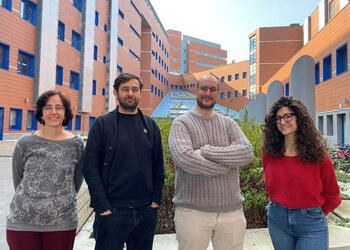
Paola Ceroni, Francesco Romano,
Marco Villa, Angelica Germinario.
(Picture UniBo)
The solution is based on luminescent silicon nanocrystals (silicon quantum dots), markers that are invisible to the naked eye and do not alter the appearance of products, while enabling rapid and reliable identification through dedicated optical systems. In addition to the emission “colour”, the technology also exploits luminescence decay time, thereby creating a temporal signature that makes the coding more robust and particularly effective for both traceability and anti-counterfeiting applications.
“This approach makes it possible to embed traceability into materials and connect it to digital systems for value-chain management,” Paola Ceroni added. “With ELISET, we aim to demonstrate that advanced research results can be translated into concrete and timely solutions to address some of the most pressing challenges of the ecological transition: from recycling quality to value-chain transparency, through to the protection of products and materials.”
Most read news