



Electric moulding of PCR pots: green process for a green application
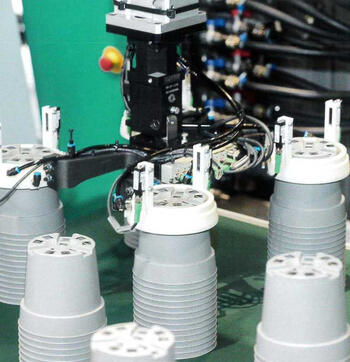
Along the path towards plastics sustainability, the use of recycled materials is assuming an increasingly important role and, consequently, the development of technologies that enable their processing to obtain high-quality products. This is what occurs at German company Osko, which produces gardening pots in post-consumer recycled polypropylene using an Allrounder 720 A all-electric injection moulding machine from Arburg in the Ultimate+ version.
The choice of the all-electric Allrounder 720 A is based on the constant attempt to optimise production processes in an energy-efficient manner and to save resources in the production of lightweight thin-walled products. The German processor also produces the Oskar pot in PBS biopolymer derived from renewable sources and biodegradable in a manner similar to wood.
In comparative tests carried out by Arburg, the machine in question showed an electricity requirement of 37 kWh/h, compared to 68 kWh/h for a standard packaging press, corresponding to a reduction of approximately 45%. The Allrounder 720 A Ultimate+ used by Osko is equipped with a targeted optimised injection unit and high-precision servomotors, whose combination enables injection speeds of up to 400 mm/s and consistent performance even at a maximum injection pressure of 2,000 bar. The combination of modern servo-technology and a precise control unit also enables the achievement of very high flow channel/wall thickness ratios, a decisive advantage in the production of thin-walled components.
Functions such as aXw Control RecyclatePilot, furthermore, enable reliable compensation for material quality variations. It monitors consistent mould filling, which translates into uniform pot quality, and ensures that colours and additives used do not compromise recyclability.

Most read news