



Margaglione, Amaplast President, takes stock of the present and future of the industry
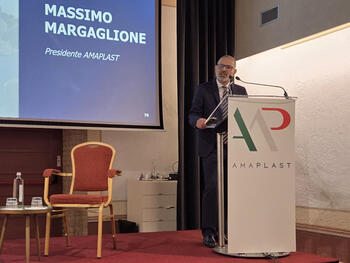
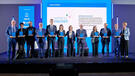
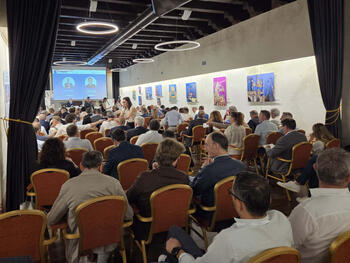
The annual Amaplast Member Assembly was held recently at Villa Baiana in Monticelli Brusati (Brescia). Amaplast is a trade association affiliated with Confindustria that brings together over 170 manufacturers of machinery, equipment, and moulds for plastics and rubber. In his address to the Assembly, President Massimo Margaglione reviewed the performance of Italy's plastics and rubber machinery industry, commenting on the findings of the sixth edition of the National Statistical Survey conducted by the Mecs–Amaplast Research Centre. The survey covered 435 manufacturing companies, employing almost 15,300 people, which generated total turnover of 4.62 billion euros in 2025 (-4.2%), with exports accounting for 73% of sales, confirming the sector's strong international orientation. According to President Margaglione, "although the sector's performance declined compared with 2024, the overall picture is not particularly alarming, both because it follows four consecutive years of growth and in light of the numerous and serious geopolitical challenges that have characterized the global environment for some time. Despite considerable difficulties, our companies have demonstrated their ability to withstand these pressures."
Exports, traditionally the industry's main growth driver, declined by 5% compared with 2024 after four consecutive years of expansion, settling at a total value of 3.41 billion euros. Commenting on the geographical distribution of Italian sector exports, Margaglione highlighted India (+40% in sales in 2025 compared with 2024), stating that "the country is experiencing an extraordinary phase of industrial and demographic development and is rapidly establishing itself as one of the most promising markets for our technologies. It is a country in which we must continue to invest, maintain an even stronger and more consistent presence, and build long-term relationships."
Turning to China (+8%), the Amaplast President emphasized that, in addition to being a major destination for Italian sector exports, the country represents "the great competitor of the next decade".
He added that "I believe it is important to acknowledge a fundamental reality: China is no longer simply a low-cost country but a world-class industrial, technological, and commercial competitor, capable of investing, innovating, achieving economies of scale, and competing aggressively in international markets. The real challenge of the coming decade will be to defend and strengthen our competitiveness against a competitor with unprecedented scale, speed of execution, and investment capacity. Meeting this challenge will require innovation, technology, sustainability, skills development, and, above all, a European industrial policy that is finally fully aware of the strategic importance of manufacturing."
The President also highlighted the resilience of supplies to US plastics processors, which actually increased by almost nine percentage points despite the difficulties and uncertainties resulting from the introduction of tariffs.
Looking at the plastics value chain as a whole, based on the latest study prepared by TEHA Group for the associations representing the sector, Margaglione noted that the plastics industry generates 15.3 billion euros in added value, second only to the automotive sector. It is therefore, he said, "an essential and strategic component of Italy's manufacturing system", which ranks second in Europe only to Germany, with the gap steadily narrowing over the past decade. Margaglione concluded by stating that "Italy has demonstrated both resilience and growth in an exceptionally challenging European environment."
During the meeting, the nine members of the General Council for the 2026–2028 term were elected: Alessandro Balzanelli (FB Balzanelli), Michele Bandera (Bandera), Elena Barrale (Euroviti) Alessandra Bosco (Inglass), Andrea Comerio (Comerio Ercole), Alberto Piva (PET Solutions), Fabiola Plebani (Mast), Renzo Privitera (Gefran) e Corrado Zanga (Uniloy).
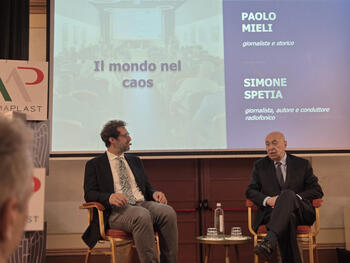
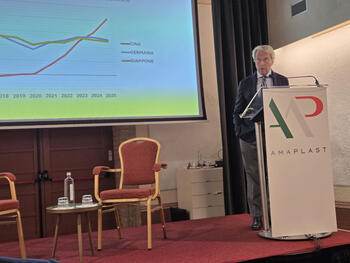
Guest speakers at the Assembly included Professor Marco Fortis, Director of Fondazione Edison, journalist and historian Paolo Mieli, and journalist, author, and radio presenter Simone Spetia. In his presentation, titled “Italian Resilience and Global Challenges”, Professor Fortis highlighted the strengths of the Italian economy, beginning with its growing trade surplus across numerous product categories, which has also improved relative to other major global exporters. Italy ranks first in the world for the diversification of its export portfolio and, in several categories of plastics and rubber machinery, improved its position and increased its market share among exporting countries during the 2019–2025 period. According to Fortis, over the next three years Italy could achieve annual GDP growth of between 0.6% and 0.7%, provided it continues to keep public debt and public finances under control, manages the conclusion of the National Recovery and Resilience Plan (PNRR) in an orderly manner, and maintains the necessary investment in renewable energy.
Paolo Mieli and Simone Spetia jointly presented an analysis of the Italian political landscape, whose future equilibria remain difficult to predict, together with an assessment of the complex international environment that Europe will need to address in a united and coherent manner. According to Paolo Mieli, conflicts throughout history have shared several common features: multiple triggering factors, their coincidence with periods of pandemic, and, ultimately, phases of profound renewal. It was this final prospect that he chose to leave with the audience as a message of hope.

Most read news