




Versalis at Plast with an integrated portfolio of complementary expertise
Versalis partecipa a Plast 2026 con un portafoglio integrato di soluzioni sviluppate insieme a Finproject e Novamont, Versalis is taking part in Plast 2026 with an integrated portfolio of solutions developed together with Finproject and Novamont, reflecting complementary expertise brought together to respond to the evolution of markets and applications. The offering presented at the fair highlights an approach focused not only on product innovation, but above all on the ability to provide concrete solutions for packaging, 3D printing and new fields of application, with particular attention to circularity, functionality, technical performance and the evolution of new regulatory scenarios.
Among the solutions on display, Versalis is presenting an offering designed for food packaging that combines circularity with the performance requirements of the sector. The product complies with the recycled-content requirements set by the Packaging and Packaging Waste Regulation (PPWR) for 2030 and incorporates secondary raw materials obtained from the recycling of polystyrene food packaging. This proposal has been developed to meet the increasingly stringent needs of the food packaging sector, combining circular raw materials with the high performance demanded by the market. Thanks to this innovative solution, recycled materials can be used in high-value-added applications without compromising the key performance characteristics required by the food packaging sector. Refence EPS 3000 PM is designed in particular for the fish and dairy markets, offering a concrete response to the need for application continuity, safe use and compliance with the requirements of the food sector. Material certification and suitability for food contact provide a guarantee of reliability and quality.
Versalis promotes 3D printing as a development platform for applications with high technical and design content. Its offering is structured around the Impressio range, which includes styrenic polymers, recycled-content solutions from the Versalis Revive family and Balance bio-attributed products, formulated for both filament and pellet printing processes. The proposal has been developed to ensure a choice of specialised grades offering processability, thermal stability and mechanical properties suitable also for medical, technical and design applications, supporting advanced prototyping, customisation and greater production flexibility.
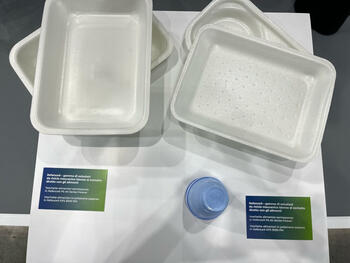
Through its integrated portfolio with Novamont, Versalis is bringing to Plast a proposal focused on compostable solutions developed to respond concretely to the new needs of the packaging sector. The focus is on Mater-Bi bioplastic applications, designed to be organically recycled while ensuring functionality in use and high performance. The offering includes solutions for rigid and flexible packaging, with and without barrier properties, such as cling film, flow packs, single-dose packs, coffee capsules, and cups and trays made of cardboard and bioplastic. These proposals are already fully aligned with the evolutionary trajectories of the market and with the emerging requirements of European legislation on material sustainability and end-of-life packaging management – starting with the Packaging and Packaging Waste Regulation (PPWR) – helping to support the transition towards increasingly circular and lower-impact packaging systems.
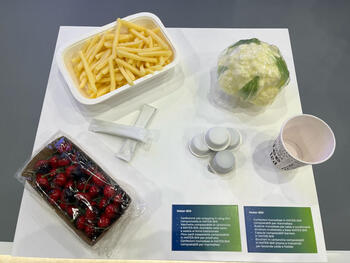
A further area of presentation is dedicated to solutions developed to support entry into, and consolidation within, new application markets, through an offering that combines performance, specialisation and support for innovation. In this context, the integrated portfolio with Finproject highlights product families such as Levirex, Padanaplast and Tecnofilm – in the various Polidan, Cogegum, Polidiemme, Tecnobond, Euroter, Eurubber and EB Prene grades – which include polymer alloys, expandable and crosslinkable polyolefin-based compounds, thermoplastic compounds, functionalised polyolefins, polyolefins crosslinkable through silane technology, and rigid and plasticised PVC. These solutions are used in sectors such as footwear, technical articles, wires and cables, pipes and fittings, windows and doors, furniture, seals, bottles, adhesive layers for multilayer food-packaging films, and evolving markets such as electric vehicles and photovoltaic cables.
For the pharmaceutical sector, Versalis is presenting the Pharmalene family, a portfolio that includes polyethylene grades and elastomers developed for high-value-added medical applications. The range includes LDPE, HDPE, EVA and LLDPE solutions intended for production processes such as film, BFS (Blow-Fill-Seal), extrusion, injection moulding and blow moulding. It also includes SEBS grades which, thanks to their linear structure and characteristics, can be used in thermoplastic compounds for the medical sector. All Pharmalene grades can also be supplied with ISCC PLUS certification in Bio Attributed (BA) and Bio-Circular Attributed (BCA) mode. The main end uses include medical devices — such as syringes, catheters, valves, filters, tubes and medical bags, aerosol masks and nebulisers, caps and seals — as well as pharmaceutical packaging, both primary packaging, in direct contact with the active ingredient, and secondary packaging. A key distinguishing feature of the Pharmalene family is the package of certifications and services currently in place, which can be further extended to other polymer resins in the existing portfolio. Thanks to the breadth and variety of its offering, Versalis is able to respond to the different application needs of the pharmaceutical market with reliable and highly specialised solutions.
In the tyre sector, Versalis is presenting a proposal that integrates technological innovation and sustainability along three strategic lines. The first concerns advanced elastomers, with the development of new-generation elastomers – in particular advanced sSBR and BR grades – designed to meet the requirements of electric mobility and high-performance tyres, improving parameters such as rolling resistance, grip, noise reduction and durability. This area also includes functionalised sSBR/BR elastomers for silica-based compounds, in particular the new Agon FX 911 grade, developed for premium, high-energy-efficiency applications. The second line concerns mechanical recycling, with solutions based on devulcanised rubber and eSBR/ELT powder masterbatches, aimed at reintegrating recycled materials into compounds and enhancing the value of end-of-life tyres through an integrated circular-economy approach. The third area is that of bio-materials, which includes bio-based plasticisers and renewable raw materials, including Matrilox PF801E, developed as a more sustainable alternative to traditional mineral oils for elastomeric and tyre applications.
A further focus is dedicated to ReUp, the Versalis brand designed for the world of furniture and home decor, offering design solutions made with polymers obtained entirely or partly from mechanically recycled plastics or from alternative raw materials, such as bio-naphtha and pyrolysis oil from chemical recycling. At Plast, a number of objects from the Opaline collection, already presented at Milano Design Week 2026, are on display as a concrete expression of ReUp’s approach to sustainable design and material valorisation.
Most read news