



Moderate but structurally driven growth in rubber demand
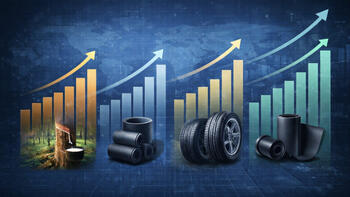
The International Rubber Study Group (IRSG) has released the latest edition of the World Rubber Industry Outlook – the twice-yearly report providing forecasts for the global economy and the automotive, tyre and rubber sectors – with projections updated through to 2032.
The global economic outlook remains stable but continues to underperform pre-pandemic trends, constrained by geopolitical tensions, elevated debt burdens, uneven regional growth, and climate-related disruptions. Global GDP growth is projected at 3.2% in 2025, easing to 3.1% in 2026. While inflation has moderated, it remains sticky, with risks linked to energy markets, geopolitical developments, climate shocks, and persistent service-sector pressures. A durable recovery will depend on stronger investment and more predictable global policy settings.
These macroeconomic conditions are expected to translate into more cautious dynamics across vehicle and tire markets, shaping the outlook for rubber demand. Global vehicles in use are projected to grow by 2% in 2025 from 2024, and the annual growth rate is expected to slow to 1.62% till 2032. Global vehicle production is expected to increase 3.1% in 2025 from 2024, and the annual growth rate will slow to 1.13% till 2032. Tire production is projected to rise mildly by 0.24% in 2025, and growth in subsequent years will be 1.46% on average till 2032.
Total rubber demand is projected to rise to 32.49 million tonnes in 2025, an increase of 2.1%, before reaching 36.57 million tonnes by 2032. Natural rubber demand is expected to grow 2% to 15.73 million tonnes in 2025, reaching 17.88 million tonnes by 2032. Synthetic rubber demand follows a similar but slightly slower path, increasing 16.77 million tonnes in 2025 and 18.69 million tonnes by 2032.
On the supply side, global natural rubber production is projected to rise to 15.24 million tonnes in 2025, 3.5% up from 2024, and to reach 17.10 million tonnes by 2032. Despite this recovery, the natural rubber market remains structurally tight. The global natural rubber balance is project to record a deficit of 488 thousand tonnes in 2025, a slight recovery from 689 thousand tonnes in 2024, but is expected to widen again to 779 thousand tonnes by 2032.

Most read news