



Europe’s plastic pipe market shows signs of recovery
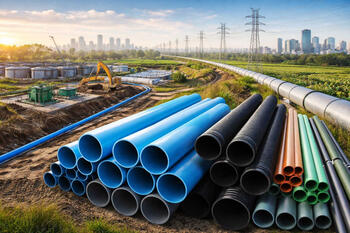
Will the economic upturn finally arrive in 2026? There is reason for optimism, at least for plastic pipe manufacturers. For some time, the European market for PVC, polypropylene and other polymer pipes has been stagnating at around 5 million tonnes per year. However, according to market research company Ceresana, demand is expected to post a slight recovery: the gradual implementation of EU directives on drinking water (DWD) and urban waste water treatment (UWWTD) is driving the expansion of water networks. Adaptation to climate change and extreme weather events is also supporting the market, stimulating investment in new pipelines in agriculture and horticulture, as well as by many local authorities—for example for pressure pipelines, plumbing systems or water treatment installations. In addition, demand is rising for empty conduits to protect power and telecommunications lines: for cable protection systems, often made of polyethylene, Ceresana forecasts growth of 1.7% per year.
The latest edition of Ceresana’s report on the European plastic pipe market distinguishes for the first time between in-building installations and external utility networks for drinking water and sewage. The market volume for in-building installations depends largely on construction activity and on energy-efficient refurbishment, renovation and modernisation of buildings. In these areas, the trend towards lightweight, durable plastics continues: particularly during refurbishments, old metal pipes are replaced with PP-R or PE-X pipes. Glass fibre reinforced plastics (GRP) are used in particular for large-diameter pipes, where stiffness and corrosion resistance are required. The market share of pipes made from fibre-reinforced composite materials remains limited. Nevertheless, Ceresana’s analysis expects GRP pipes to grow by around 3% per year, although the outlook depends on a few major projects. The research company also estimates growth of 1.4% for polyethylene pipes, used mainly for drinking water, irrigation and parts of gas transmission networks. Another factor underpinning rising demand for plastic pipes is the growing adoption of trenchless installation methods.
From 2026 onwards, Europe’s construction industry could return to growth. Many projects, however, are being slowed by bureaucratic permitting procedures, a shortage of skilled labour, and rising construction and financing costs. Local authority projects are particularly affected by budget cuts; on the other hand, substantial public infrastructure investment programmes are in place. With a “European Grid Package” and new large-scale energy infrastructure, the European Union aims to strengthen the trans-European energy networks, in particular cross-border infrastructure for the transport of electricity, gas and hydrogen. In most European countries, commercial construction, infrastructure and military facilities are outperforming residential building. The current strong focus on artificial intelligence is also driving solid growth in data centre construction.

Most read news