




3DPlastLab: multimaterial moves out of the laboratory and becomes the new frontier of additive manufacturing
For years, 3D printing has focused primarily on geometry. Today, the real challenge is different: controlling not only the shape of objects, but also the very nature of the material from which they are made. This is where multimaterial comes into play, one of the most promising directions in contemporary additive manufacturing and one of the key themes of 3DPlastLab, the new innovation hub that will animate Plast 2026 from 9 to 12 June at Fiera Milano Rho. At 3DPlastLab, the topic will be explored through some of the most advanced international experiences, bringing together academic research, industrial development and new design applications.
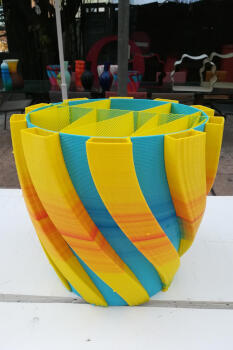
Among the key players will be Gimac, which will present a technology developed for large-format multimaterial printing, regarded as one of the most advanced currently available. The innovation lies in the ability to deposit different materials simultaneously within the same layer, overcoming some of the main limitations of traditional multimaterial technologies based on alternating filaments and printheads. This approach makes it possible to increase production speed, material continuity and process reliability. At 3DPlastLab, this technology will be applied to the production of large-format architectural elements, such as façades and internal partitions capable of changing colour, behaviour and function according to the distribution of materials.
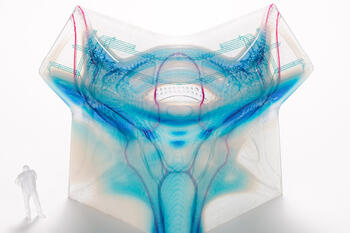
Among the key players will be Gimac, which will present a technology developed for large-format multimaterial printing, regarded as one of the most advanced currently available. The innovation lies in the ability to deposit different materials simultaneously within the same layer, overcoming some of the main limitations of traditional multimaterial technologies based on alternating filaments and printheads. This approach makes it possible to increase production speed, material continuity and process reliability. At 3DPlastLab, this technology will be applied to the production of large-format architectural elements, such as façades and internal partitions capable of changing colour, behaviour and function according to the distribution of materials.

The journey into multimaterial continues on an entirely different scale with Jochen Mueller, Associate Professor at Johns Hopkins University (Baltimore, USA). Mueller works in the field of micro- and nanoscale additive manufacturing, developing proprietary systems capable of producing ultra-thin elastic films integrated within complex devices. Thanks to a multimaterial and multi-viscosity approach, his team has succeeded in producing elastic membranes just 18 microns thick, opening up new prospects for soft robotics, inflatable devices and electro-active actuators. This example demonstrates that multimaterial is not only a matter of large structures, but a technology set to redefine the future of intelligent devices and soft robotics as well.
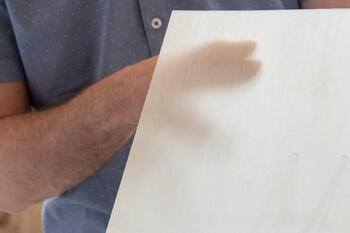
Completing the programme will be Giulio Malucelli, Full Professor at DISAT – Department of Applied Science and Technology (Politecnico di Torino), who will present one of the most surprising materials to have emerged recently: transparent wood. The process starts with the controlled removal of natural lignin, leaving the fibrous structure of the wood intact. The matrix is then infiltrated with transparent polymers, obtaining a material that retains some of the mechanical properties of wood while acquiring transparency, thermal insulation and new application potential. This is not 3D printing in the strict sense, but it is a perfect example of how materials research is redefining the very boundaries of advanced manufacturing.
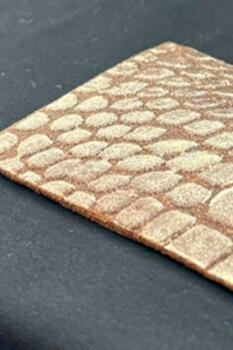
A further element in the multimaterial landscape will be represented by Marinella Levi, Full Professor at the Department of Chemistry, Materials and Chemical Engineering “Giulio Natta” of Politecnico di Milano and founder of the +LAB laboratory, which has long been engaged in the development of advanced materials for additive manufacturing. Her work demonstrates how multimaterial can become the meeting point between sustainability and industrial performance. On the one hand, research has led to the creation of a new generation of 3D-printable composites entirely based on plant-derived raw materials, culminating in the development of innovative sustainable alternatives to leather, including a remarkable surface that reproduces the aesthetics of crocodile skin using exclusively plant-based components. On the other hand, the team has developed fibre-reinforced thermoset composites intended for high-performance industrial applications, a technology that has given rise to the spin-offs Moi Composites and Moi Dental and has already reached a level of industrial maturity. This pathway shows how materials research can move simultaneously on two fronts: imagining new sustainable scenarios and turning them into concrete, scalable production processes.
Taken together, these projects describe a profound transformation. The future of additive manufacturing will not be defined solely by the ability to print increasingly complex forms, but by the possibility of designing geometry, material properties, sustainability and functional performance at the same time. It is precisely this convergence between materials, design and production that 3DPlastLab aims to stage at Plast 2026: a place where multimaterial ceases to be a research topic and becomes a concrete preview of the manufacturing of tomorrow.
Most read news