



Using sunlight to break down PFAS
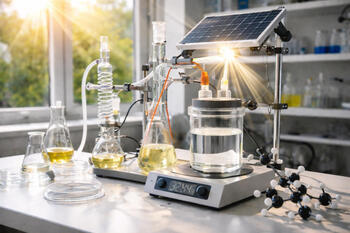
An international team of scientists led by the University of Bath (England) has developed a new catalyst – a substance that speeds up chemical reactions – that uses sunlight to break down so-called “forever chemicals” prevalent in the environment and known to accumulate in the human body. They hope this technology could in the future be scaled up and used to detect or remove these persistent chemicals from the environment.
The study is based on an easy-to-make prototype carbon-based catalyst, which could be used to break down PFAS (polyfluoroalkyl substances), a group of water-repellent and incredible stable chemicals.
Scientists from the University of Bath worked with colleagues from the University of São Paulo (Brazil), University of Edinburgh (Scotland) and Swansea University (Wales) to develop a photocatalyst based on carbon nitrite combined with a rigid microporous polymer called PIM-1. The polymer helps bind PFAS to the catalyst, which uses light to break it down into carbon dioxide and fluoride, a chemical found in some toothpastes.
As anticipated, as well as using it to break down PFAS, the technology could also be used in a sensor for forever chemicals, by detecting the fluoride that is given off. Whilst it is currently at the prototype stage, and the research team is now looking for industrial partners to scale up and optimise the technology.

Most read news